How I measure
spanning' what’s possible
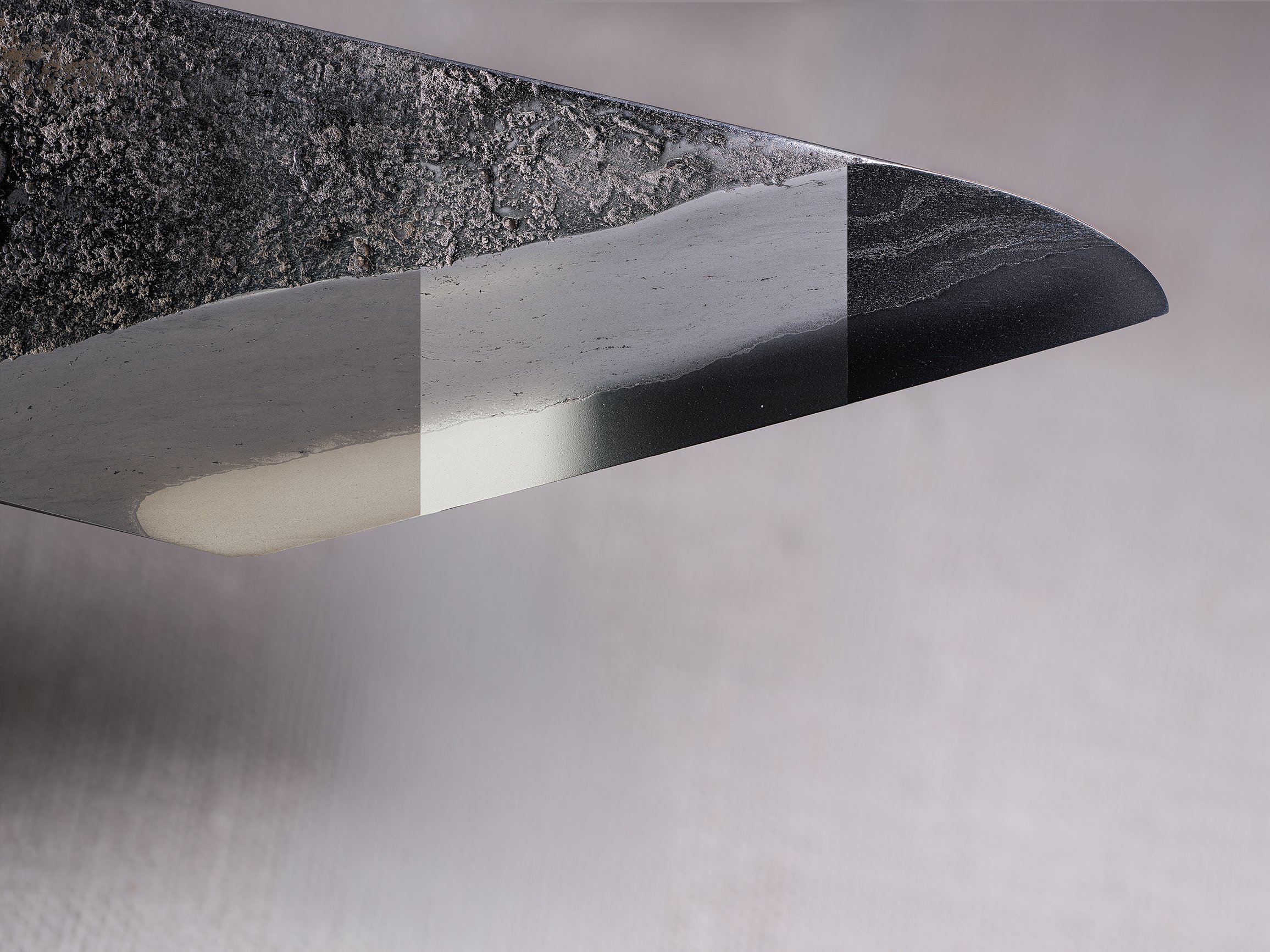
Left: soft Ohira uchigumori bench stone — the soft hazy end.
Middle: Haze finger stones — the strongest contrast.
Right: KREAM Detail — richly reflective. The dark mirror end of the range.
Everything else sits between these three; the numbers say where.
Three finishes on the same blade,
spanning' what’s possible
The method
How I measure.
The kasumi scale.
Haze → mirror
0no reflection
5perfect mirror
Contrastclad/core
0 %no contrast
100 %highest contrast
Negative contrast: when the core is brighter than the clad. −40 % is the theoretical limit.
Brightnesson clad
0 %darkest
100 %brightest
Every finish on this site is measured and described.
The field has long rated stones by hardness and grain size — useful numbers, and I reach for them too, but neither predicts the finish a stone will leave. So I measure the finish itself. Here is how — and, just as honestly, where the measurement stops.
To be clear: I'm not claiming to understand these stones better than anyone. I don't speak Japanese. I just measure the finish instead of only describing it.
The shorthands we all use
I bet most of your finishing stones are rated between 3.5 and 4.5 — and my 3.5 could be your 4.5. It's a bet I'd happily make, because I already know how it turns out.
-
I reach for these as much as anyone. In my own descriptions I'll talk about how hard a stone is, how it grinds, how big the grain runs. They're useful shorthands, and they matter — but there's a point where each one stops predicting the finish you'll get. I know that point from using them every day, not from standing above them.
Hardness, and how a stone feels to work. The LV scale — soft around 2.5 to 3, the middle 3.5 to 4.5, hard above — is what most people reach for, and so do I, at the bench. But it slips in two ways. First, it's relative to whoever is holding the stone: my 3.5 might be your 4.5. There is no fixed zero, so the number travels badly from one hand to another.
Second, and less obvious, it depends on how the stone is mounted. Take one stone. As a small, unstable koppa with an uneven bottom, it feels harder — it rocks, it resists, and the hand reads that resistance as hardness. Glue that same stone to a heavy plate, planted and stable, and it feels softer. Same stone, same hand, same day, a different reading — because the mounting changed the feel, not the stone. And everything I'd call comfort or ease of use rides on exactly the same thing: how a stone handles depends on the hand, the mounting, and the steel you're working, every bit as much as on the stone itself.
None of this makes feel worthless — far from it. In a consistent setup, the same hand and mounting across twenty or fifty stones in a row, it becomes a reliable comparative sense, and I lean on it every day. But as a transferable number, one that means the same thing to a stranger, it doesn't hold.
Grain size. This one sounds the most precise of all — a figure in microns. But two things undo it. The first is that a stone doesn't have a grain so much as a grain in a given state: a jnat flattened on a diamond plate presents a different surface than the same stone conditioned with a nagura, which is different again from one worked directly under the blade. Each raises its own effective grain. So the number describes a preparation, not the stone — and it changes the moment you prepare or use it differently.
The second is that you cannot really measure it anyway. I've held the finest probe most of us own — a record player's stylus, a point that reads a groove in microns — against a dry, scratched stone, and even that can't fix a stone's grain to a single number. It's a beautiful thing to try. It doesn't work.
Mohs and scratch hardness measure whether one material scratches another. That tells you something about durability, and almost nothing about the finish a stone leaves. Shore hardness I've tried directly: nearly every jnat I own reads at the very top of the scale, clustered so tightly the number can't tell two genuinely different stones apart — and the finest, thinnest finger stones would shatter under the tester's point. A measurement that returns the same answer for everything, and breaks the most delicate stones outright, isn't measuring what I sell.
The trouble runs through all of them. They measure the stone, or a state of it, or the hand holding it — when what a buyer cares about is the finish.
None of this means grain and hardness don't matter. They matter enormously — they are much of why a stone leaves the finish it does. But they don't reliably predict it. A stone can surprise you: the hardness and the grain point one way, and the finish comes out another. And even when they hold true, they can't be communicated predictably — my 3,5 is your 4,5, and a grain figure describes a state, not a stone.
So while I do keep hardness and grain in mind — they tell me something — I don't lean on them too hard, and I try not to describe them too firmly, because they can mislead. What I trust most, and what I can put in front of you, is the effect: the finish a stone leaves. That is what you want from it, and it is the thing I can measure and show you.
So I measure the finish.
The stone's origins. The mines and the strata are real knowledge — Nakayama, Ohira, tomae, suita — centuries of it, and knowing where a stone comes from is part of knowing the stone. I'll always share what I can read: the mine, the layer, the character that points there.
But here is the honest truth about this market, and I've never seen a shop say it: there is no way to be certain where a stone comes from. The great mines closed decades ago. Stones have passed through estates, dealers, and resales, and the labels grew more confident as the evidence grew thinner. After fifteen years and close to a thousand stones through my hands, I can offer an informed judgment — sometimes a strong one — never a certainty. And I won't claim to do better than that, because nobody can.
So on my listings, an origin is stated at the confidence I actually hold: named when the provenance is solid, "likely, from the character" when my eye says so, and "unknown" when it is — with the measurements standing either way. Because that's the point of this whole page: the name tells you a stone's lineage, as far as anyone can know it. The numbers tell you the stone in front of you. Only one of the two can be checked — which is exactly why the numbers, not the name, carry my descriptions.

The sharpest point most of us own — made to read grooves in microns — and it still can't tell me a stone's grain size.
What I measure, and why it's the light
A kasumi finish is an optical thing — the difference in how hard and soft steel scatter light. So I measure the light itself. One blade, one fixed setup, everything I'm not measuring held constant.
-
A kasumi finish is an optical thing. It is the difference in how hard steel and soft steel scatter light — the hard core throwing a reflection, the soft cladding breaking it up. Measure the light, and you are measuring the finish directly, with nothing in between.
The mirror surface is smooth and directional — it sends light back where it came from. The haze is finely broken — it scatters light every way at once.
Every blade is photographed clean and dry — wiped with Zeiss cleaning fluid before the shot, never oiled. Oil darkens the cladding and fills the texture: the color contrast rises, but the difference between haze and mirror disappears — and that difference is exactly what these pictures exist to show.
So every finish on this site is photographed the same way: one reference blade, one fixed position, one fixed lighting geometry, the same camera settings, the same focus stack. The only thing allowed to change between one photograph and the next is the stone. That is the whole discipline — to measure a finish, you hold constant everything you are not measuring.
The blade itself carries its own controls. Its unpolished forge scale sits in every frame: rough scale under raking light is exquisitely sensitive to the smallest shift, so if the blade has moved, the scale shows it. A grey backdrop sits in every frame too, and reveals whether the light has drifted. And a dark panel beside the bevel splits the light — one side lit by direct reflection, the other only by raking light — so a single photograph shows each part of the blade under both regimes at once. That is what lets a finish be measured rather than merely shown.

Photographers meter the light before the shot. I meter the finish — same instrument, same reason.
The four numbers
Every finish gets four readings: core (haze→mirror), cladding reflectiveness, cladding brightness, and contrast. What each one means — and the surprising fact that a bright cladding is…
-
From those photographs, four numbers describe each finish: two on a line from 0 to 5, and two in percent.
The two haze → mirror readings, on the core and on the cladding, stay on 0 to 5, because they are a position along a line: 0 is perfect haze, 5 is a perfect mirror (the scale at the top of this page).
Contrast and brightness are in percent. I still measure them the way a photographer does: contrast as a gap in stops of light (a ratio, on a log scale, read from the unedited 16-bit files), brightness as the lightness (L*) of the cladding. Those are the right instruments, but nobody can picture 1.9 stops or an L* of 51. So I put both on a plain 0 to 100 % ruler. Contrast is the gap in stops divided by the four stops my scale spans; brightness is the lightness on its own 0 to 100 scale. 0 % is no gap, or the darkest; 100 % is the widest gap the scale shows, or the brightest. The stops are what the measurement is made of. The percent is what it says.
Core (mirror ↔ haze) — how much brighter the hard core is under direct reflection than under raking light alone. A mirror throws the light source straight back and goes near-black without it: a large number. A haze scatters light both ways evenly: a small number. This is the main axis, and it orders every finish from the softest haze to the hardest mirror.
Cladding reflectiveness (mirror ↔ haze) — the same measurement, on the soft cladding. This separates finishes the core alone cannot: two stones may leave identical mirror cores, while one keeps the cladding hazy and the other brings it close to a mirror.
Contrast — how far apart the core and cladding sit under the same raking light. This is the separation your eye actually sees across the face of the blade. On this reference blade the core almost always sits darker than the cladding under raking light, so the direction is usually the same and the number is simply how wide the gap is. One finish turns it around: KREAM Detail, worked the other way, leaves a dark cladding over a hazy core. The core is then the lighter one, and the contrast reads below zero (−20 %).
Cladding brightness — plainly, how light or dark the cladding comes out, on its own scale from dark to light. This one sounds like it should be the same as mirror-versus-matte, but it pulls the opposite way — and the photographs prove it on sight. A matte cladding scatters light in every direction, so under raking light it looks bright and milky, returning light everywhere, including at your eye. A mirror cladding throws light one way only, so unless that reflection points at the lens it looks dark, almost black — like the core. So the brightest claddings are the haziest, and the darkest are the most mirror-like: the reverse of what you'd guess. That link is strong, but not perfect — a few finishes break it. A KREAM haze, and several of the finger stones — the haze, clarity, and soft-haze grades — leave a cladding that comes out unusually bright, bright enough to look more polished than a bench-stone finish — yet measure them and they are still genuinely matte, almost no mirror in them. Reflectiveness alone would call them the same as a plain matte cladding; only the brightness tells them apart. Which is exactly why I measure both: you cannot judge how polished a cladding is by how light it looks.
One structural thing falls out of this, worth knowing before you read any finish: high contrast is only available at the mirror end. Contrast is the gap between a dark core and a bright cladding — but the core only goes dark if it is polished to a mirror. A hazy core stays middling-bright no matter what, so it simply hasn't the range to throw a strong contrast. If you want drama — a bright cladding leaping off a near-black core — the core has to be a mirror. A hazy core gives a beautiful, quiet finish, but never a loud one. The ceiling on contrast is set by the core, not the cladding.
The words are borrowed from photography and colour science on purpose — mirror, haze, contrast, stops, reflection, scatter — because that is what the thing is. Hardness tells you little about how a surface behaves. The light tells you everything.
Why some numbers grey out
A card claims only what I measured this product doing. So on some cards the core and contrast grey out — the product was tested on the cladding, and the core carries an earlier stone's work, not this one's. It's only honest to show what a product actually produced under the blade I measured, and leave the rest grey.
-
The cards show what I tested — no more. Bench stones I tested across the whole blade, the hard steel core and the soft iron cladding both, so all four numbers stand in full ink. Finger stones and KREAM I tested on the cladding, so those cards show the cladding numbers and grey out the core and contrast. That greyed core isn't this product's doing — it's whatever an earlier stone left on the hard steel, sitting there while I worked the cladding. I grey it rather than print it as a result, because showing it would credit this step with a finish it didn't produce.
This isn't a limit on the products — a finger stone or KREAM can work hard steel too, whether taken across a clad blade or used on a honyaki or mono-steel blade, and I may test more of those cases in time.

Worked the cladding, not the core — so the core greys out.
How I know the numbers are real
The image you see is the file I measured. Download it, measure it yourself, and you'll land on the same values — nothing hidden between what I measured and what…
-
A fair question: how do I know these numbers describe the finish, and not just the photograph? Two ways, and both are worth stating.
First, they are ratios in stops, which makes them immune to how bright the exposure happened to be. The main measurement — the core's mirror-to-haze reading — reproduces to within a few hundredths of a stop, even reshot on another day with the backdrop a third brighter.
Second, the same finish photographed at different positions on the blade gives the same numbers, to within a few hundredths. If position changed the reading, the method would be measuring position, not finish. It doesn't. The finish stays constant; the position and the lighting wash out.
And then the part I like best: the image you see is the file I measured. It is processed only enough to look right on a pale screen, identically for every finish — a little flat, on purpose, because I would rather it be honest than flattering. So you don't have to take the numbers on faith. Download the image, measure it yourself, and you will land on the same values. That is the point of measuring in ratios from the raw file: there is nothing hidden between what I measured and what you can check.

The whole finish in one mark: cladding above, core below, the gap between them the contrast. Each half the blade's own colour — check it.

Where the measurement stops
Two things I measured and chose not to publish as numbers — the sharpness of the reflection, and fine detail — because the number would lie. I'd rather tell you why.
-
The first is the sharpness of the reflection — how tightly it holds together. This is the difference between a mirror and glazed porcelain: a mirror throws the light back at you crisply; porcelain reflects too, but softly — a spread, milky gloss rather than a clean image. (This is a real distinction, not a fussy one — industrial gloss meters measure exactly these as two separate things.) I tried to put a number on it, but it fails on hazy finishes, where there is no sharp reflection to measure at all. So it falls apart exactly where much of my range lives.
The second is fine detail. A number for detail is corrupted by a single scratch or a speck of dust — it cannot tell fine polish from fine contamination, and it would not survive a reshoot.
So I leave both of these to the eye, which reads gloss and texture reliably and is not fooled by one speck. The four published numbers, by contrast, each average over a whole zone, so a scratch or a speck washes out, and they hold steady from one session to the next.
You can't measure a portrait. But you can measure the pigments — and that is all these numbers do.

On the hard core the reflection cuts off sharply; on the cladding it fades slowly; on a true haze there is no edge left to measure at all.
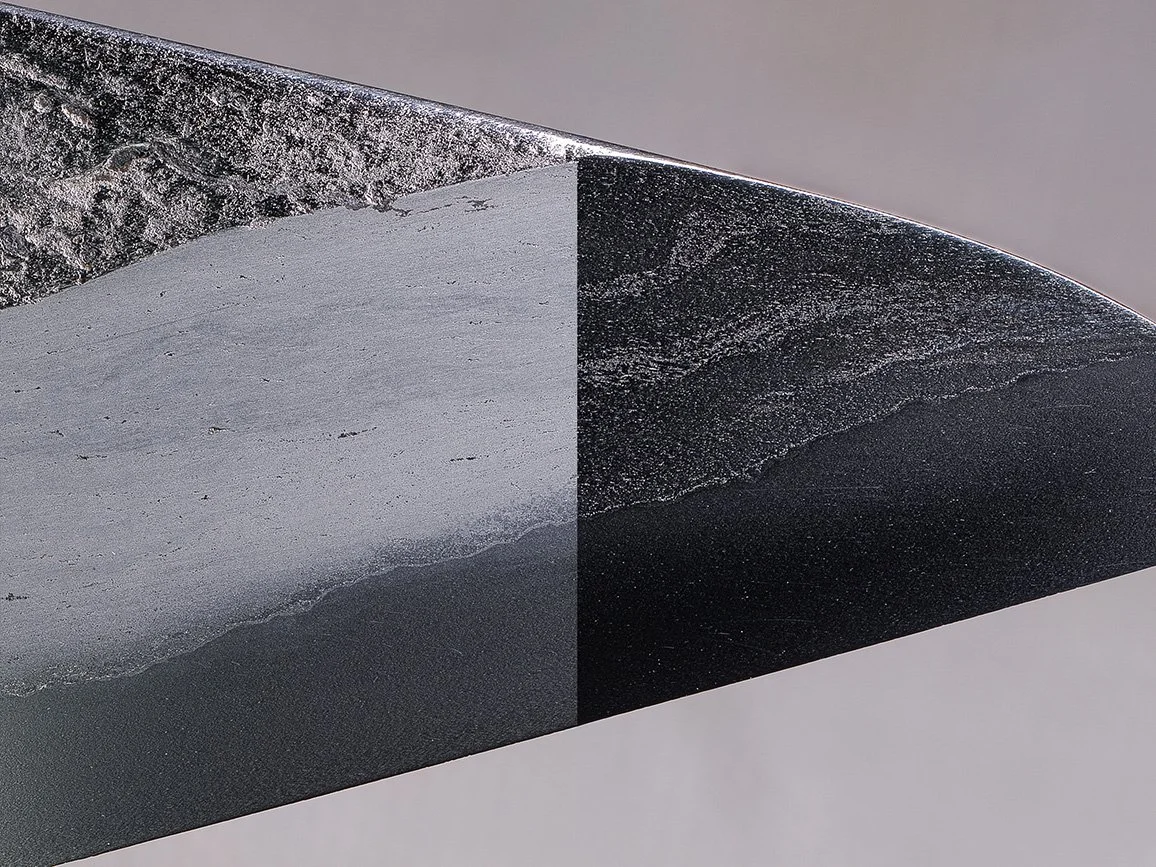
A variance measure reads more detail on the scratchy surface than the clean one — it counted the scratches as detail. This is why detail stays with the eye.
The one thing to keep in mind
Every number is measured on one reference blade, one steel, one light. It's a common ruler for comparing my stones honestly — not a promise about your knife.
-
Every number here describes the effect of a stone on this one reference blade, this one steel, under this one light. It is a controlled, comparable, reproducible statement — and, as far as I know, the only one of its kind for natural stones. But it is not a promise about your knife. A different steel, a different cladding, a different grind will take the same stone differently.
That gap is what the testing covers. Before a stone is listed, it has been worked — on clad steel, on stainless, on honyaki; on single bevels and double. Different blades ask different things of a stone, and sometimes opposite things: the ura of a single-bevel wants an edge finished smooth — a stone with a scratch in it has no business there — while a stainless kitchen blade wants an edge with more bite. No stone answers both ends well, and that isn't a flaw; it's what character means. The testing isn't a pass or a fail — it's how I find out who a stone is for, and the listing carries the answer.
The edge is part of it too. A finishing stone that leaves a beautiful kasumi and a dead edge has failed at half its job — so every stone is worked to the edge, and the edge is cut with. The stones I sell are fine enough that the edge goes through any food easily.
What the numbers give you is a common ruler: the ability to compare any stone to any other stone on the same blade — which is exactly the question the field usually settles with adjectives. They rank my stones against each other, honestly, on one blade. So you can look across the finishes, find the one you actually want, and know which stone leaves it — instead of buying a word and hoping. And they say so.

The marker's position on the range is the meaning. The same scales carry across every stone, finger stone, and KREAM, so any finish can be placed against any other.
And in case the numbers made me sound certain: I'm not claiming to know these stones better than anyone. I'd just rather show you a finish than describe it — and let you check it for yourself. Not a claim to know more. A way to hide less.








Nine finishes, one blade. The range isn't the blade's — it's the stones'.